LOADING

Building Partnerships that Last

We adapt our collaboration approach to fit your goals and business context. Whether it's a fixed-scope project, a flexible time & material approach, or a dedicated team that grows with your brand - the way we work always fits you, not the other way around.

The Most Common Engagement Models

We explore the four engagement models most often used in digital projects, especially AI and software development projects, and how The Wonder Apps works with each one.

01

Fixed-Price Model

A Fixed-Price model is one of the most traditional and widely used engagement approaches in software development. It works best when the project scope, timeline, and deliverables are clearly defined from the start. The client and vendor agree on a fixed cost for a specific set of outcomes, creating predictability and clear accountability for delivery.

Unlike the Waterfall model (which often lacks flexibility), modern Fixed-Price projects can still follow Agile principles, using short iterations, demos, and regular feedback cycles to ensure progress stays aligned with business goals. This combination allows you to maintain cost control without losing adaptability.
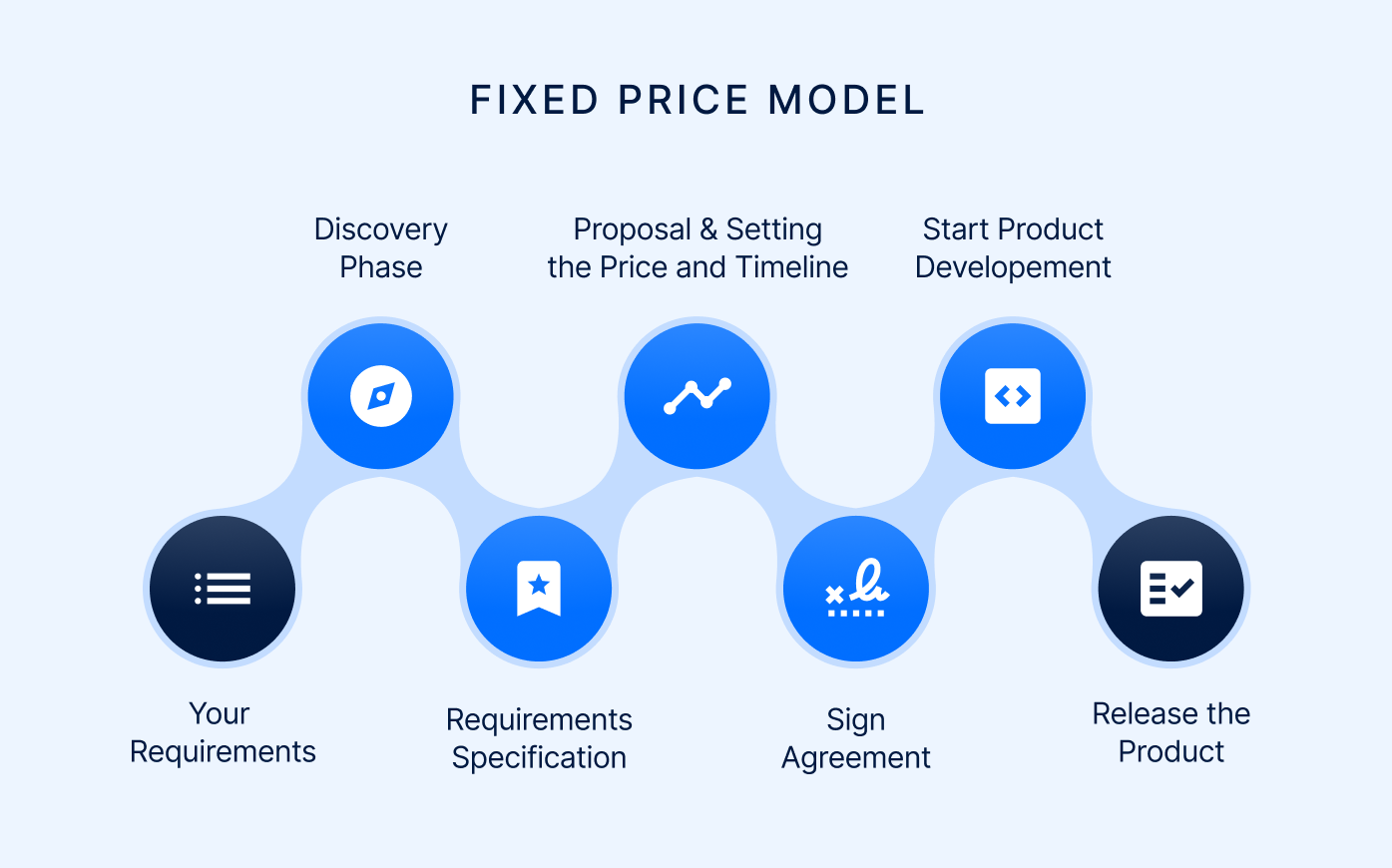
Fixed-Price Model Process Flowchart

✅ When to Use the Fixed-Price Model

  • Small to mid-sized projects with well-defined deliverables
  • Clients with strict budget requirements
  • Projects with clear milestones and acceptance criteria
  • Website migrations or platform upgrades with known scope
  • MVP development with fixed feature sets

✓ Advantages

  • Predictable costs and timeline
  • Clear scope and deliverables upfront
  • Lower management overhead for clients
  • Easy budget approval and planning
  • Defined accountability and milestones

✗ Considerations

  • Requires detailed upfront planning
  • Less flexibility for scope changes
  • May not suit evolving requirements
  • Change requests can incur additional costs
  • Not ideal for exploratory or R&D projects
02

Time & Material (T&M) Model

The Time & Material (T&M) model is built for flexibility and adaptability. Instead of agreeing on a fixed scope upfront, the client pays for the actual time and effort invested by the development team. This model is ideal for projects where requirements may evolve or priorities change frequently, such as ongoing optimization, A/B testing, or early-stage product development.

In a T&M setup, the focus is on continuous value delivery. You can test, iterate, and pivot without being restricted by fixed contracts, which is perfect for dynamic industries like AI and software development, where technology and requirements evolve rapidly.

How Does the T&M Model Work

  • The project is divided into short iterations or phases
  • After each iteration, the client reviews progress, approves outcomes, and can re-prioritize next steps
  • Billing is typically based on hourly or sprint-based rates
  • Complete transparency through detailed time tracking and iteration-based reporting
  • Full control over budget allocation and feature prioritization

✅ When to Use the T&M Model

  • MVPs or proof-of-concept projects
  • Ongoing maintenance and support projects
  • Developing new AI/ML functionalities with evolving requirements
  • Building custom integrations and modules
  • Running A/B tests or performance optimization
  • Starting collaboration before scaling to a dedicated team
  • Research and development initiatives

✓ Advantages

  • Maximum flexibility and adaptability
  • Can pivot based on results and feedback
  • Pay only for actual work performed
  • Easy to scale up or down
  • Perfect for evolving requirements
  • Lower commitment barrier to start

✗ Considerations

  • Less predictable final cost
  • Requires active client involvement
  • Needs ongoing budget monitoring
  • Timeline may extend if scope grows
  • Requires trust and transparency
03

Dedicated Team Model

The Dedicated Team model is built for long-term collaboration and strategic growth. Instead of project-based delivery, you get a fully integrated, cross-functional team that works exclusively on your product, acting as a true extension of your organization.

This model provides ongoing agility, continuous delivery, and deep business alignment, making it the most popular collaboration framework among enterprise companies. For years, global players have relied on dedicated teams to support complex, long-term digital operations.

How Does the Dedicated Team Model Work

  • The client defines long-term goals and expected outcomes rather than a fixed scope
  • The vendor assembles a dedicated team (designers, developers, QA engineers, AI specialists, etc.) that works exclusively for the client
  • The collaboration follows Agile methodology, allowing continuous delivery, sprint planning, and backlog prioritization
  • The client retains full transparency and control, while the vendor manages recruitment, HR, performance, and process improvement
  • Flexibility to add or remove specialists as priorities evolve

✅ When to Use the Dedicated Team Model

  • Continuous product development and platform growth
  • Long-term AI/ML optimization and innovation cycles
  • Businesses that value stability, agility, and deep collaboration
  • Enterprises needing consistent development velocity
  • Projects requiring specialized expertise over extended periods
  • Organizations scaling their development capacity

✓ Advantages

  • Deep understanding of your business and product
  • Consistent development velocity
  • Full team integration with your organization
  • Easy to scale team size up or down
  • Lower cost than building internal team
  • Access to diverse specialized skills
  • Continuous improvement and optimization

✗ Considerations

  • Higher monthly commitment than project-based
  • Requires long-term planning and vision
  • Needs strong communication processes
  • Best for established products with ongoing needs
04

Staff Augmentation Model

The Staff Augmentation model provides on-demand access to highly skilled professionals who seamlessly integrate into your existing team. Unlike a dedicated team that works independently, augmented staff members operate as direct extensions of your in-house team, following your processes, tools, and management structure while bringing specialized expertise exactly when you need it.

This model is perfect when you have solid internal processes and technical leadership but need to scale your capacity quickly, fill skill gaps, or accelerate delivery without the overhead of full-time hiring. You maintain complete control over day-to-day operations while we handle recruitment, HR management, and performance oversight.

How Does Staff Augmentation Work

  • You define the specific skills, experience level, and duration needed (e.g., "Senior AI/ML Engineer for 6 months")
  • The Wonder Apps sources, vets, and provides carefully matched professionals from our talent pool
  • Augmented staff work directly with your team using your tools (Jira, Slack, GitHub, etc.) and follow your workflows
  • You manage their daily tasks, priorities, and performance just like internal employees
  • Flexible scaling: easily add or remove specialists as project needs evolve
  • Transparent billing based on actual time worked (hourly, daily, or monthly rates)

✅ When to Use Staff Augmentation

  • Need to scale development capacity quickly without long-term hiring commitments
  • Have specific skill gaps (AI/ML, DevOps, specialized testing, etc.)
  • Short to medium-term projects requiring specialized expertise
  • Peak workload periods requiring temporary capacity boost
  • Strong internal project management and technical leadership in place
  • Want to "try before you hire" for potential full-time roles
  • Need immediate access to talent without recruitment overhead
  • Maintaining existing workflows and processes while adding capacity

✓ Advantages

  • Rapid onboarding and immediate productivity
  • No recruitment, training, or HR overhead
  • Flexible engagement duration (weeks to years)
  • Easy to scale team size up or down
  • Lower cost than full-time hiring
  • Access to specialized, hard-to-find skills
  • Full control over daily operations and priorities
  • Try-before-you-hire option for future permanent roles
  • Maintain existing team culture and processes

✗ Considerations

  • Requires strong internal management and leadership
  • May need initial time for team integration
  • Client responsible for day-to-day task assignment
  • Less effective without clear processes and workflows
  • Need existing project management infrastructure

Staff Augmentation vs. Dedicated Team: What's the Difference?

Staff Augmentation: Individual specialists integrate into YOUR team, follow YOUR processes, report to YOUR managers. You control the "what" and "how" of daily work.

Dedicated Team: A complete cross-functional team works exclusively on your project but operates as a self-managed unit with their own team lead, following Agile ceremonies and delivering results based on agreed outcomes. You control the "what" but the team manages the "how."

05

Hybrid Model & Retainers

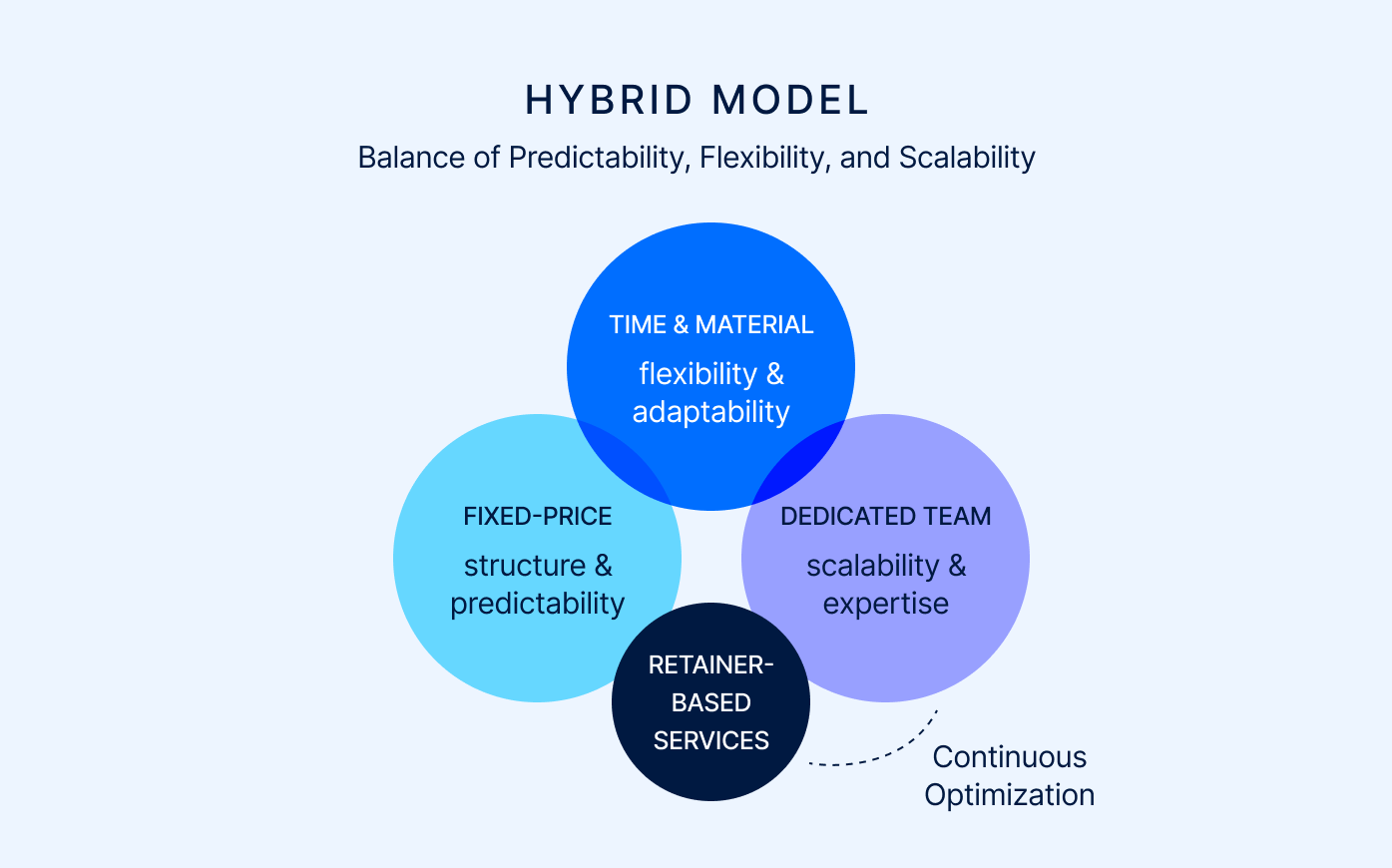
Sometimes one size doesn't fit all, and that's perfectly fine. The Hybrid Model combines the best elements of different engagement approaches, typically mixing the structure and predictability of a Fixed-Price project with the flexibility and scalability of a Time & Material model or Dedicated Team.

This setup provides both control and adaptability, allowing companies to plan for stability while still leaving room to innovate as the project evolves. It's a particularly powerful model for growing businesses that balance stable product development with ongoing optimization, testing, and experimentation.

Hybrid Model Process Flowchart

How Does the Hybrid Model Work

  • A project often starts with a fixed scope (such as migration or initial development) for predictable delivery
  • Once launched, ongoing enhancements, testing, and optimization continue under a Time & Material or Dedicated Team setup
  • The mix of models provides cost efficiency for predictable tasks and flexibility for evolving goals
  • Retainer-based services (SEO, testing, maintenance) can run in parallel with main development
  • One coordinated partnership handling multiple workstreams efficiently

✅ When to Use the Hybrid Model

  • Enterprises working on multiple projects simultaneously
  • Growing companies that need both structure and flexibility
  • Brands combining fixed-scope projects with ongoing optimization
  • Businesses that benefit from continuous improvement through retainers
  • Organizations with diverse needs across development, testing, and operations

✓ Advantages

  • Best of all models combined
  • Predictable costs for core work
  • Flexibility for evolving needs
  • Unified communication and coordination
  • Can handle multiple workstreams efficiently
  • Optimal resource allocation

✗ Considerations

  • Requires clear communication frameworks
  • More complex initial setup
  • Needs mature project management
  • May require multiple contracts/agreements

Quick Comparison Guide

Choose the right engagement model at a glance

Model Best For Flexibility Cost Predictability Time to Start
Fixed-Price Clear scope, fixed budget projects Low High Medium (requires detailed planning)
Time & Material Evolving requirements, MVPs High Medium Fast (can start immediately)
Dedicated Team Long-term partnerships, continuous development High High (monthly commitment) Medium (team assembly required)
Staff Augmentation Scaling capacity, filling skill gaps Very High Medium (flexible duration) Fast (rapid specialist deployment)
Hybrid Complex enterprises, multiple workstreams Very High Medium-High Medium (customized setup)

How to Choose the Right Engagement Model

Selecting the right engagement model depends on your goals, project maturity, and level of involvement

🎯

Define Your Goals

Do you have a clear vision or are you exploring possibilities? Fixed scope or evolving requirements?

💰

Consider Your Budget

Do you need predictable costs or can you flex based on value delivered? Short-term or long-term investment?

⏱️

Evaluate Timeline

Is this a one-time project or ongoing development? Quick delivery or continuous evolution?

👥

Assess Your Team

Do you have internal technical capacity or need a full team? Hands-on or delegated management?

Still Not Sure?

Our team will guide you through each step and help you choose the right engagement model. With our AI-driven project analysis, we deliver exactly what you need with the best possible approach.

Schedule Free Consultation

How We Start Working With You

Every collaboration begins with your business, your goals, and your challenges

Before writing a single line of code, we work to understand what success looks like for your brand and how technology can help you achieve it. From the start, we help you choose the engagement model that fits your scope, timeline, and ambitions.

Our Integrated Team

  • Account managers and strategists shape the vision and strategy
  • Project managers ensure structured, transparent delivery
  • AI/ML engineers and developers bring solutions to life
  • QA specialists and test automation engineers ensure quality
  • DevOps engineers maintain infrastructure and deployment
  • UI/UX designers create exceptional user experiences
📊

Transparent Tools

Jira for project management, Slack for communication, comprehensive documentation

🤖

AI-Powered Delivery

Proprietary AI tools accelerate decision-making and predict risks

🔄

Agile Methodology

Continuous delivery with sprint planning and regular feedback

📈

Continuous Improvement

Learning from every project to deliver better results each time

Frequently Asked Questions

Common questions about our engagement models

What if my project scope changes midway?

No problem! The Wonder Apps's Time & Material or Hybrid engagement models are designed to handle evolving priorities. They give you full flexibility to adjust scope, timelines, and deliverables as your business needs shift without slowing progress. Even in Fixed-Price projects, we build in milestone reviews to accommodate necessary adjustments.

Can I switch between engagement models later?

Absolutely! Many of our clients start with a Fixed-Price or Time & Material project and then transition into Dedicated Teams as their business grows. We make the transition seamless and help you scale at the right pace for your needs.

How does The Wonder Apps ensure transparency and accountability?

We use industry-leading tools for project management (Jira), communication (Slack), and time tracking. You'll have real-time visibility into progress, deliverables, and resource allocation. Regular sprint reviews, demos, and status reports keep you informed at every stage.

Can The Wonder Apps choose the right engagement model for me?

Yes! Our Account Managers will guide you through each step. Using our AI-powered project analysis tools, we can assess your requirements and recommend the optimal engagement model based on your goals, budget, timeline, and team structure. We've done this hundreds of times and know what works.

What's the minimum commitment for each model?

Fixed-Price: Project duration (typically 2-6 months)
Time & Material: Flexible, can start with 1-month sprints
Dedicated Team: Typically 3-6 months minimum, renewable
Hybrid: Varies based on project structure

Do you offer trial periods or pilot projects?

Yes! We often recommend starting with a short Time & Material engagement or a small Fixed-Price pilot project. This allows both sides to build momentum, establish trust, and prove value before scaling to a larger commitment. Many of our long-term partnerships started this way.

Ready to Discover Your Perfect Engagement Model?

Let's design a partnership that fits your goals perfectly. Schedule a free consultation with our team to explore which engagement model will deliver the best results for your business.